TikTok was owned and operated by ByteDance, until a finalized transfer of its U.S. operations on Jan. 22, 2026. Now, emotions are mixed, and users seem to disagree with the changes made.
TikTok is beloved in the American community—it consistently keeps its place in the top 10 of the most downloaded apps on both the App Store and Google Play Store. Its rise to popularity began in 2020 due to the COVID-19 pandemic and mandatory quarantine.
The battle for TikTok ownership began back in August 2020 because ByteDance is a Chinese owned company. Fears rose that the Chinese government could be using TikTok as a propaganda machine or taking advantage of American citizens’ data.
In China, the government can freely tap into companies under its jurisdiction’s user data, including ByteDance and thus TikTok. Similarly, the Chinese government could force TikTok to push certain agendas into the algorithm. However, there hasn’t been sufficient evidence whether either of these have happened. Still, there are concerns because it’s possible.
In 2024, according to CNN Business, a law signed by then-President Joe Biden required the U.S. version of TikTok be separated off from ByteDance, or it’d be banned in the United States. Although President Donald Trump had been against TikTok in his first term—during his second term he pushed the deadline for the sale repeatedly.
Finally, last fall, a deal was struck and the deadline was January 23 to finalize the contract. The three managing investors are Oracle for their cloud storage services, investment firm MGX, and private equity group Silver Lake—holding around 15% each. ByteDance still holds 19.9% and their respective stakeholders hold around 30%.
Although the transfer was for security concerns, many feel as if TikTok has become less safe. Noemi Sanchez, an SAS Senior, states, “I do not feel safer using the app now. This is because of location tracking, and knowing that the American government currently is using any means of finding individuals no matter the state of their citizenship, it concerns me.”
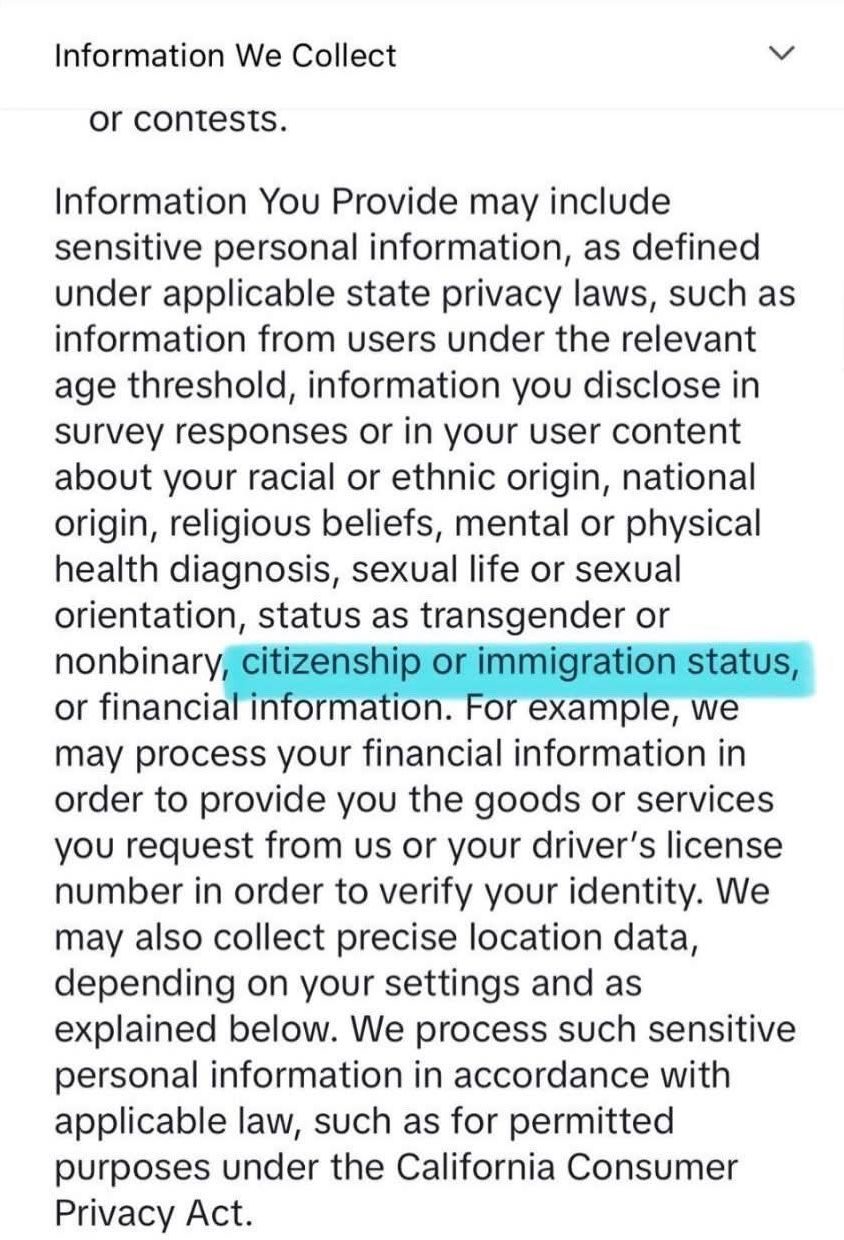
Citizenship tracking is a common issue many raise, as a new privacy policy and terms of service rolled out at the same time as the transfer. A new section in TikTok’s Feb. 5 2026 privacy policy states sensitive information—defined as “racial or ethnic origin, national origin, religious beliefs, mental or physical health diagnosis, sexual life or sexual orientation, status as transgender or nonbinary, citizenship or immigration status, or financial information.”—may be processed for services.
However, this doesn’t mean this information hasn’t been processed before. Moreover, the section was added due to state laws, such as the California Consumer Privacy Act in which corporations have to specify what information they’re using from the consumer—particularly with reference to the “sensitive information” outlined. Additionally every platform has to adhere to it, not just TikTok.
Still, because this information is now in American hands, a closer entity, many worry for their safety. “With the current political climate, I feel less safe. I’m worried that the government might try to track down me and my family, as my close family are people of color.” Isabella Higuera, a STEM senior and TikTok Creator, says.
Precise GPS tracking adds to people’s concern. It’s a new technology the Joint Venture brought. It uses location tracking to personalize the For You page and advertisements. With the pile of political climate, fears are ballooning and leads to users taking precautions. Higuera says, “I originally had a post or two with my face, however, after the new [Terms of Service] was put into effect, I deleted those videos and shut off my location tracking.”
Additionally, the algorithm is lacking. It is currently being retrained on US data, according to CNN Business. However, retraining has set back the algorithm. “My [For You page] completely ‘reset.’ It was frustrating, and I had to re-curate my algorithm and tailor it back to my own likes.” Higuera states. Sanchez echoes this sentiment, “After the shift, I always would have to reload my FYP because of how many repetitive videos I would see. Often my TikTok would feed me videos I saw a whole week ago, but claimed I never saw it, liked it, or interacted at all with it, when I knew I already did.”
Higuera’s solution was to “manipulate the algorithm by mass liking, reposting, and overall interacting with posts I do like and completely ignoring the ones I don’t.” However, even that doesn’t help entirely or can be too time consuming. Sanchez simply gave up with the app due to it, “The app got more frustrating rather than boring under these new security standards. It’s feeding repetitive, censored, overall overwhelming content that doesn’t even load half the time.”
Creator reach seems to have suffered too. As a creator, Higuera says, “My views definitely did take a hit. Immediately after I accepted the new TOS, my next post only got 100 or so views in the first few hours, which had been a shock, as my most recent ‘new norm’ was getting up to 1-2k views at least within the first few hours.” Though, Higuera explains, “My videos are still reaching my core audience…this viewer to non-viewer ratio is unsurprising and wholly expected.” It hasn’t been a complete hit.
Censorship holds another layer, as users state important content hasn’t been pushed to them. “Creators often have to mask their true informing content with TikTok ad content. I’ve seen people hold up signs while they say the advertising words, talking about the political climate like it has to be whispered or it won’t be heard.” Sanchez states. “Posts about the TOS, political posting that is anti-ICE or anti-Trump, and anything that has to do with critiquing the current administration and people affiliated with them, has been mostly if not completely shadow-banned.“ Higuera explains. Shadow-banning is defined as a user’s content being blocked from being viewed by others, unbeknownst to them.
Ultimately, the new system has been largely unfavored. A multitude of users switched to different platforms such as YouTube or Instagram due to the recent changes. The privacy and national security risks have been solved in a way—whether they were from users moving platforms or the new TikTok Joint Venture. These platforms are American-owned, so the goal of having American data in American hands was completed. However, it came at a cost for the consumer and TikTok as a whole. Opinions vary, and it seems that it’s up to individual users to decide if this change was necessary and beneficial.
Sources:
https://www.cnn.com/2026/01/22/tech/tiktok-us-deal-closes
https://www.pbs.org/newshour/show/national-security-experts-argue-u-s-tiktok-deal-falls-short
https://www.tiktok.com/legal/page/us/privacy-policy/en