The North Hollywood High School community has become aware of a new and dangerous malady spreading across the campus.
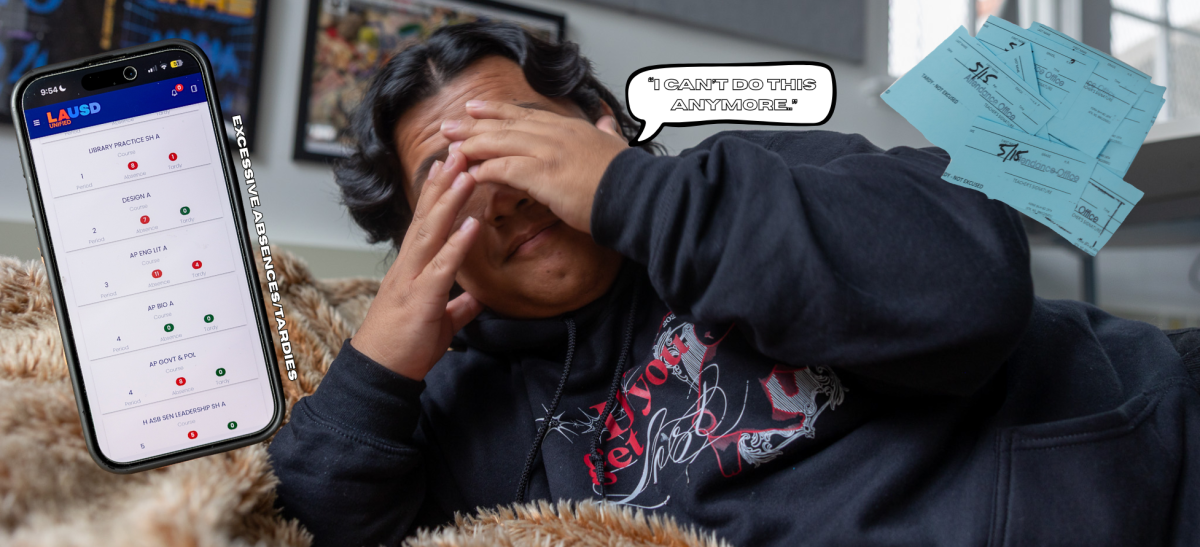
Seniors — in high school or in college — are those generally vulnerable to infection. Once a life after school appears on the horizon, the formerly scrupulous scholar may see their motivation evaporate, their attendance falter, and their commitment flee. At that point, they are demonstrating clear symptoms of senioritis.
HGM senior Claire Han thinks that “after college apps, people start caring a little bit less about their grades and their performance and attendance.” She adds that students’ public image “doesn’t matter as much after college apps are in already — or at least that’s what they think.” Senioritis manifests as a result.

Han finds the situation to be pervasive. “It happens so much that it’s normalized, so people don’t care too much about it, and even parents think that it’s OK.”
SAS senior Sebastian Dumelod has also witnessed the condition’s spread. He recalls that his AP English Literature class was historically so full that “sometimes we don’t have seats for everyone.” This time of year though, “that isn’t a problem because there’s always someone absent.”
Scientific findings have also uncovered real psychological roots to the phenomenon.
Psychology Today connects senioritis to the concept of expectancy-value theory: People get motivation towards a goal from their expectations (whether they think they will be successful) along with its value (whether they think it is worth working towards).
For high school seniors who already have their graduation or college plans set, it is as though their long-term goals have already been met. So what more do they expect to achieve from continuing to focus, and what more value is there in academic commitment?
Likewise, in a 1981 academic journal article, Richard L. Hayes of Bradley University (Peoria, Illinois) argued that “senioritis represents a predictable developmental crisis.” Interpreting the condition as simply laziness is “a basic misunderstanding.” For humans, it is even expected.
Seeing that the condition may have basic roots to it, it is perhaps unsurprising that senioritis “epidemics” have actually been documented for decades.

“The High School is undergoing an attack of ‘Senioritis’ at present,” the Grant County Vidette of Pond Creek, Oklahoma reported. For that issue’s readership, the “present” was March 1908 — nearly 12 decades ago.
Similarly, in April 1937, a journalist for the Little Hawk Weekly of Iowa City High School lamented, “Strange is the affliction that strikes high school students this time of year. When it strikes those who graduate in June, it is called senioritis. Symptoms of the disease are varied and sometimes obscure. A tendency to let work slide is one sign… A feeling of supreme laziness is a good symptom.”
Is senioritis a problem? Dumelod thinks that “the fact that a bunch of students kind of just miss class here and there” can be disruptive, to the extent that teachers may need to re-teach concepts to actually give everyone the information they need. That “isn’t fair to those who were in class, because then they have to relearn the topic.”
At the same time, Dumelod adds, the situation may be inevitable. Senioritis is “always gonna be there,” he believes, and “you can’t really enforce a rule for seniors not to come, because they’re going to find a way not to come.”
Sherry Madaus of the Daily Northwestern of Oshkosh, Wisconsin, writing in 1970, also seemed to perceive something unavoidable in senioritis’ yearly menace. “Beware all you juniors,” concluded a report on a local outbreak, “lest you too find yourselves coming down with senioritis around this time next year.”
Indeed, our juniors will come to know what our seniors do now, and exactly what the classes of 1908, 1937, and 1970 did in their times: The end is almost here!