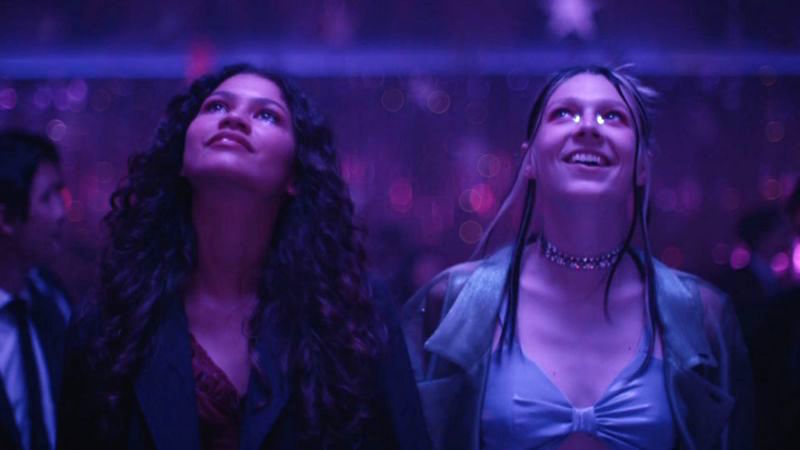
Since its launch, “Euphoria” has been a sensation, giving Gen Z gritty plots and years’ worth of moodboard fodder. Vibrant colors, atmospheric lighting, and glittery looks all characterize the show’s aesthetic. As “Euphoria” reenters the cultural conversation with its third and final season, it’s important to consider who really shaped its iconic look: Petra Collins.
Collins is a Toronto-born and New York City-based photographer whose work centers on young women, fame, and coming of age narratives. Collins’s photography inspired Sam Levinson, the creator of “Euphoria,” and she helped develop the show before being abruptly dropped from the production just before filming began. 
“Euphoria” quickly became wildly popular, with an 80% critics’ rating on Rotten Tomatoes and the second-highest ratings on HBO behind “Game of Thrones.” Collins, however, was not credited for the success of a show she shaped. She’s even spoken about feeling pressure to change her artistic style because of its association with “Euphoria.”
“I’m Team Petra Collins,” SAS senior and aspiring cinematographer Aidan Mora says. “I’m really glad that her contributions made it into the show. I obviously really wish she got the proper credit. We probably could have seen some cooler stuff, honestly, if she was director, or even executive director of some of these episodes. It’s a shame, and more wasted potential.”
It’s impossible to say where Euphoria would be now if Collins had been allowed a more lasting role in the project, but Mora believes it would have been rewarding to watch the show’s style be explored by its originator.
 Collins’s influence was the strongest in “Euphoria”’s first season, which was developed with her direct input in pre-product. Of the style in this first season, Mora says, “[It] spoke to a lot of people due to its use of color. It had a lot of really unrealistic LED choices as far as a lot of scenes, and it’s very atmospheric and pretty. I think that goes to show what the show was trying to aim for: how everything feels so big and bright and vibrant and emotional all the time when you’re a teenager.” Mora says that “Euphoria”’s expressiveness, much of which was inspired by Collins, has influenced his own style as a filmmaker.
Mora isn’t the only one who’s been inspired by this style. “Euphoria”’s use of color in lighting and makeup has helped the show resonate with wide swaths of Gen Z, making it into the cultural phenomenon it is now.
SAS senior David Bautista recalls “Euphoria”’s fast popularity after its release. “When Euphoria first came out,” he says, “there were so many TikTok trends centered around not only Labyrinth’s [the first season’s composer’s] music, but [also on] the makeup aesthetics of the different characters.” This huge cultural impact stemmed largely from “Euphoria”’s aesthetic — an aesthetic that had been informed by Collins.
As “Euphoria” has continued into its third, last, and current season, it’s had no direct input from Collins, and these seasons have arguably suffered as a result. “I feel like it definitely lost the thematic storytelling it had in its first season,” Bautista says. As of publication, the third season of “Euphoria” has only a 39% audience approval rating on Rotten Tomatoes. Though “Euphoria” has perhaps lost its edge with Sam Levinson at the show’s helm, Collins has continued to infuse pop culture with her colorful, glittery brightness.
Since being dropped from “Euphoria,” Collins has worked with popular brands like Miu Miu and Skims and has directed music videos for celebrities like Olivia Rodrigo, Carly Rae Jepsen, and Charli XCX. This work within youth-oriented celebrity spaces has secured a place in culture for Collins’s unique style.
Petra Collins’s work has shaped the visual language of Gen Z, but she rarely gets recognition for this achievement. Instead, credit is given to Levinson, who brought her into the mainstream, or to the celebrities she works with, like Rodrigo. Still, Collins is a quietly powerful force in shaping youth aesthetics.