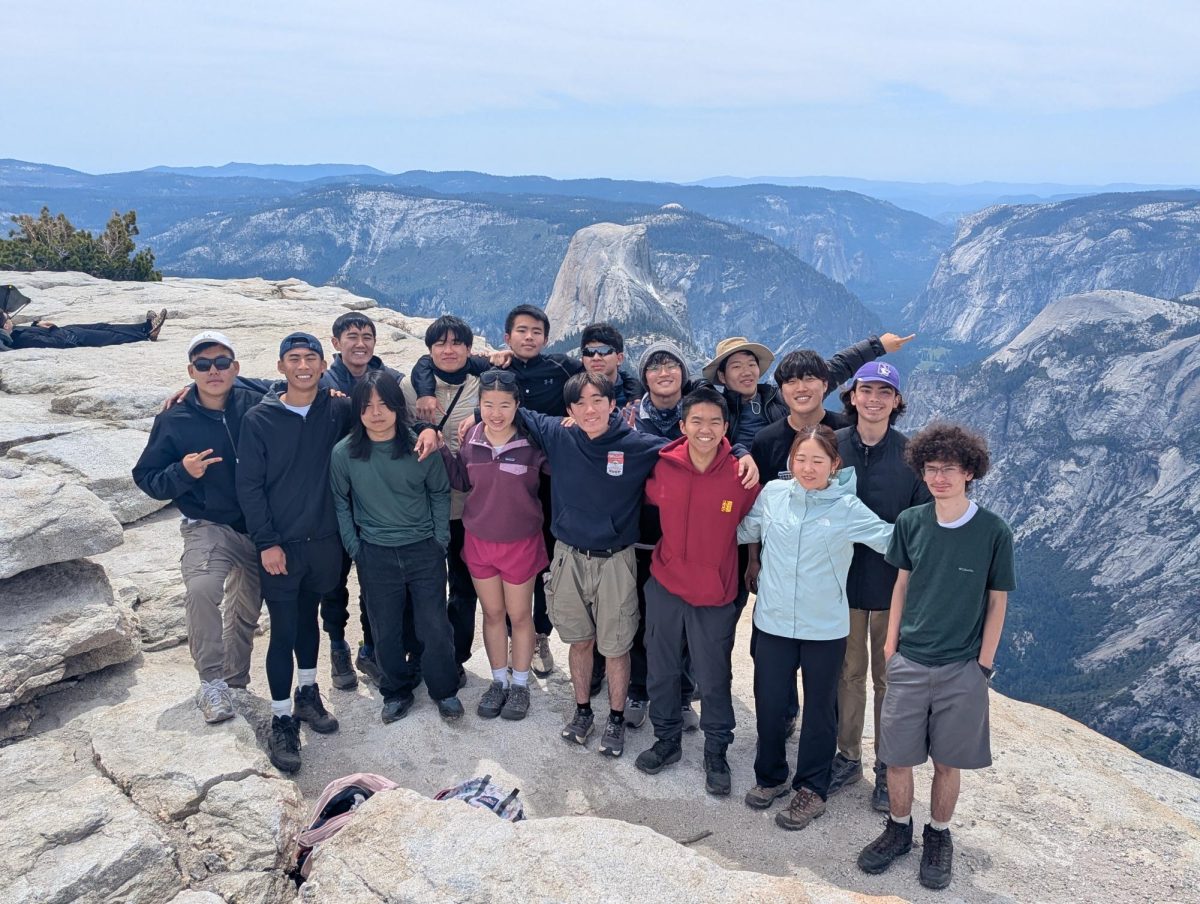
Every year, Yosemite National Park is flooded with visitors — last year, more than four million. From Sunday, May 17 to Thursday, May 21, 2026, a few dozen of those visitors were from the HGM senior class, accompanied by Mr. Maine, Ms. Deutsch, Mx. Tien, and several parent chaperones.
Yosemite, a picturesque valley in the Sierra Nevada mountains, features world-famous granite cliffs and waterfalls. It has a long and complex history, both before and after its establishment as a national park in 1890. HGM seniors experienced pieces of that history firsthand in their five-day itinerary of hikes and exploration.
_
Sunday:
The seniors arrived at Curry Village, an area with tent cabins, food, and outdoor spaces.
Curry Village began in 1899 as “Camp Curry,” founded by married couple Jennie and David Curry, both teachers from Indiana. Though Camp Curry opened with only seven tents, it rapidly expanded as Yosemite became a more popular tourist destination. Throughout the twentieth century, the site survived numerous economic, environmental, and logistical challenges.

_
Monday:
Most students left in the morning to traverse a set of seemingly endless switchbacks: a steep, strenuous trail to the top of Yosemite Falls.
At 2,425 feet, Yosemite Falls is one of the largest waterfalls on the continent. The steep trail leading to the summit was first constructed between 1873 and 1877 by prominent trail-builder John Conway. For the first few years of the trail’s existence, Conway actually owned it personally, and it only became government property in 1885 after a legal battle.
_
Tuesday morning:
Students were exhausted from Yosemite Falls, so they went on a shorter hike near Mirror Lake. When they reached Mirror Lake, however, they realized that it is barely a pond.
The appealing name is from a prior era. In the mid-1800s, residents and authorities named the small lake for its reflective properties, and it became a growing tourist destination.
In earlier eras of the Park, authorities believed that artificial modification was an acceptable mode of cultivating the natural landscape. With this philosophy, a series of dams was constructed beginning in 1884 to manually expand the size of the lake and prevent sediment from making it smaller.
By the 1970s, however, attitudes had changed, and Park authorities began allowing the lake to evolve naturally, gradually filling with sentiment and shrinking.

_
Tuesday evening:
Mr. Maine, the trip leader and a science teacher, shared an overview of the park’s geological, natural, and earlier human history.
The current shape of the valley was predominantly carved by glaciers, which appeared and vanished as the Earth cooled and warmed over millions of years, long before human presence in the area.
More recently, like so much of the United States, Yosemite’s history also has a tragic side: the destruction of the indigenous groups who originally resided there.
The Southern Sierra Miwoks or Ahwahnechee, predominantly hunter-gatherers who were the primary ancestral inhabitants of the valley, consistently suffered from American involvement in the area, first by the actions of miners and militias, and later by repressive government policies.
The community managed to survive in a fragmented state until its final village was eliminated in the 1960s, after which remaining Ahwahnechee descendants were scattered. Only recently has their history been recognized.
_
Wednesday:
A small group of students left before dawn with Mr. Maine to reach Clouds Rest, a peak overlooking the valley that requires a grueling climb to reach. Most others took the famous Mist Trail, which travels along the Merced River to Vernal and Nevada Falls.

According to the earliest surviving documentation, from the 1860s, the Mist Trail already existed at that point. After the State of California purchased it in 1882, however, authorities further developed the path with stone steps that still characterize the trail today.
To avoid descending those steps (which are slippery) along Vernal Falls, the hikers took a detour, including the Clark Point overlook, for their return. Its name commemorates Galen Clark (1814–1910), a Canadian-American naturalist who dedicated most of his life to Yosemite. Clark was appointed Yosemite’s first public “guardian” after the area was preserved through a land grant in 1864.
_
Thursday:
The journey home.
With their trip, the HGM seniors glimpsed one of the most exquisite natural landscapes in the United States. From there, they returned to their own (if less natural) landscape: Los Angeles.