
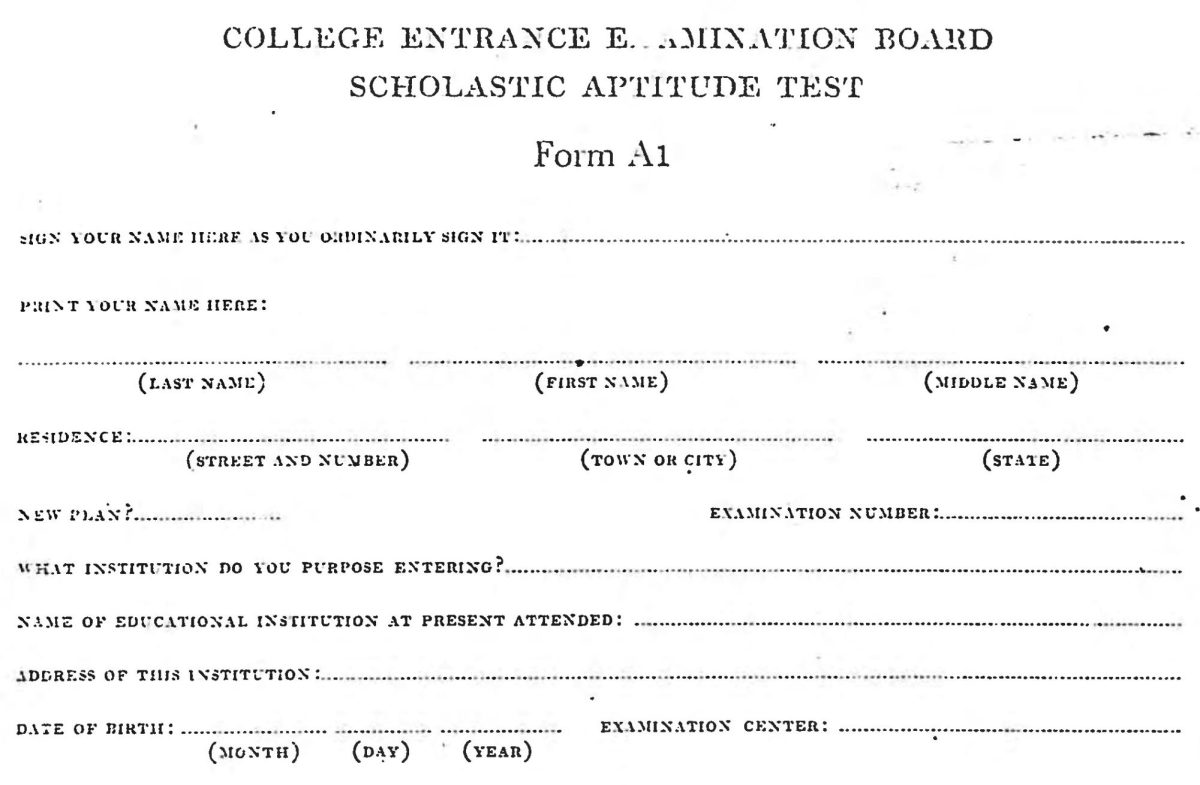
On June 23, 1926, about 8,000 American students took the first “Scholastic Aptitude Test.” A century later, on March 18, 2026, many North Hollywood High School juniors took what is still known as the SAT.
Though the SAT—today an online assessment of reading, writing and math skills—remains an enduring part of American education, its story is not straightforward. In fact, in recent years, it has been a topic of considerable controversy. Much of the debate concerns the test’s origins and early development.
In the late 1800s, the United States became increasingly interested in standardized testing. Around 1900, the College Entrance Examinations Board—now the College Board—was founded as part of this movement, aiming to test the American student population.
Interest in methods of supposedly quantifying intelligence only increased with the research of French psychologist Alfred Binet and American psychologist Lewis Terman, whose work in the 1910s eventually led to the IQ test. Other assessments, developed by Robert Yerkes, were used by the U.S. military during World War I.

After the war ended in 1918, Princeton University psychologist Carl C. Brigham began adapting Yerkes’ military test for students. The result was the SAT, which more and more institutions adopted over the next few decades.
Brigham believed that standardized testing would continue to yield benefits in coming eras. “At present our knowledge of what constitutes a good test is limited…But each year that tests are used, our knowledge will increase,” he stated in a 1926 interview.
“Some day, means of obtaining an accurate, complete picture of a new student’s mind and his possibilities may be found. If so, the effect on education will be almost revolutionary,” he added.
Retrospectively, though, a major complication arises: Race was deeply involved. In the early 20th century, many Americans, including Brigham, promoted the concept of eugenics.
The eugenics movement, now recognized as based in pseudoscientific racism, promoted selective breeding of human populations—in other words, influencing who could have children and with whom. This was rooted in the notion that some groups had genes that gave them physical and intellectual superiority over others. Naturally, certain varieties of white people were placed at the top of the hierarchy, and people of color were put at the bottom.
Brigham, in his 1923 book “A Study of American Intelligence,” claimed that it “is declining, and will proceed [declining] with an accelerating rate” because of the nation’s racial and ethnic diversity. Something like the SAT would help define who could advance into more elite education, fostering their supposedly superior intelligence.
Needless to say, that is no longer the College Board’s mission statement. Today, they say, “The SAT allows every student—regardless of where they go to high school—to access opportunities that will shape their lives and careers.” Not all scientists and educational leaders agree, however.
The debate is over how much SAT scores should matter in college admissions. As data collected by the Brookings Institute indicates, white and Asian students overall receive significantly higher SAT scores. In 2020, students with high scores (700 or above) in math were 43% Asian and 45% white, while only 6% Hispanic or Latinx and 1% Black. In contrast, those in the low score range (300 to 390) were 2% Asian, 23% white, 43% Hispanic or Latinx and 26% Black.
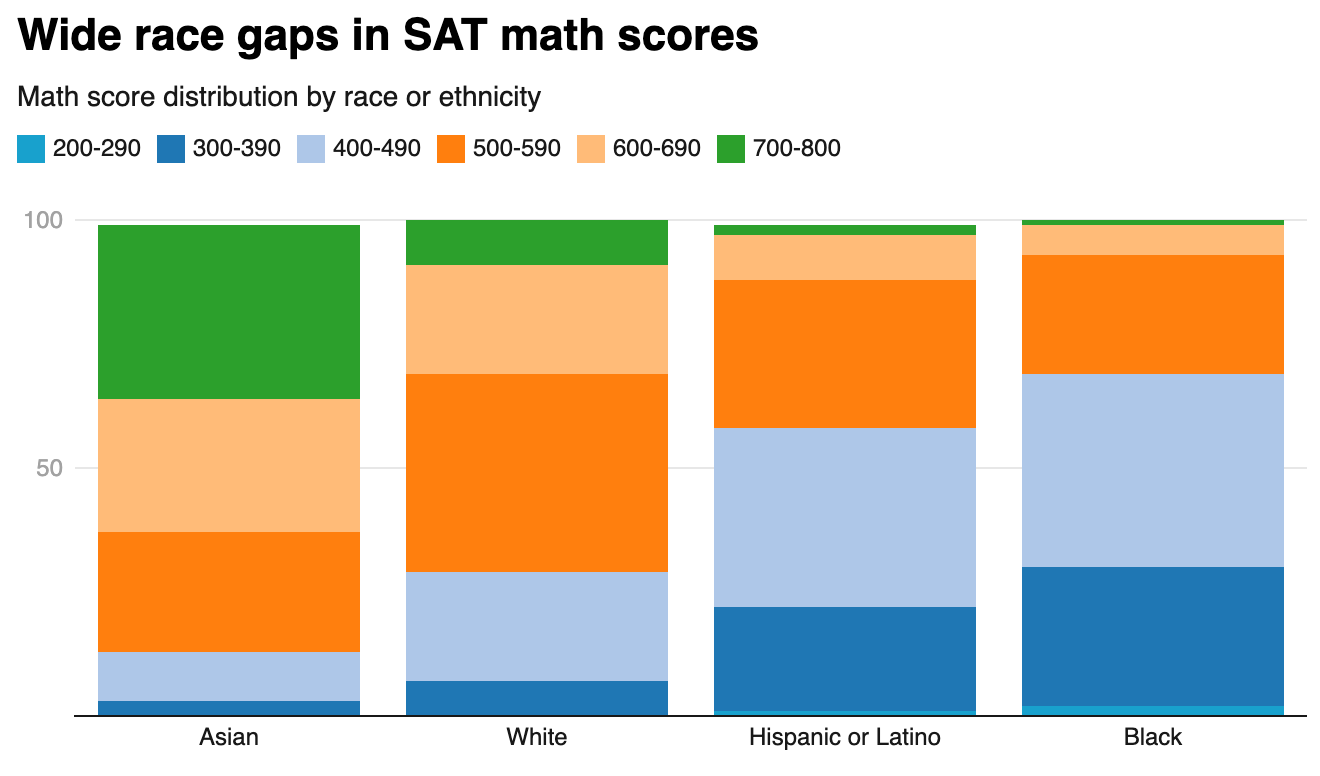
There are similar issues for students from lower socioeconomic classes. The general trend fits into the “achievement gap,” the notion that all students are not given equal opportunities and resources to succeed academically.
As a result, opponents argue, the SAT perpetuates underrepresentation of marginalized groups at selective colleges. It inhibits the U.S. from increasing the equity and inclusiveness of its society. Acknowledging these arguments, during the COVID-19 pandemic, many colleges—including the University of California system—stopped requiring SAT scores for admission.
On the contrary, others contend that moving away from the SAT is not the right tactic to close the achievement gap. Some data suggests SAT scores are an important benchmark that accurately predict college success, especially when considered holistically with the rest of a student’s academic profile. And they can even help boost the opportunities of students from disadvantaged high schools by providing a universal metric separate from grades and other achievements.
For these reasons, many colleges, including some of the nation’s most prestigious institutions (like Harvard and Yale) have been moving back towards the SAT.
Of course, the SAT is today designed to ideally minimize cultural and racial bias, moving it away from its originally racist intentions. But does its basic concept still define intelligence and achievement in terms too narrow to be inclusive and equitable?