
Scholarships are everywhere and the overwhelming majority of them are stressful for seniors and juniors alike. The dreadful dark stormy cloud hanging over students with the ideas of debt and college funds is always a problem at this time of the school year. How could a student’s life be easier? A guide to scholarships, of course.
There are so many different scholarships for students, such as academic-based, athletic-based, military-based, first-generation based, income-based, etc. One of the most common kinds of scholarships are merit-based and need-based.
Anastasia Lamanskaia, a senior at NHHS, speaks her mind on her experience with scholarships. “I couldn’t have even considered applying to colleges without scholarships.” And, “I personally have a financial need kind of scholarship which means I have a scholarship because of my family income. I know not all scholarships are like that.”

Merit-based is essentially a reward; the students who get these scholarships are rewarded for their exceptional achievement in academics, athletics, or the arts. Need-based scholarships are awarded to students prioritized for their financial circumstances or restrictions. 89% of college prep students have a background family income of 65,000 or under, taking things like college applications and dream schools out of the picture. For more information about the difference click here.
The average cost of a four-year college, per student, is 153,080 dollars. What single parent household is going to be able to afford that? Not even that, what student by themselves is going to be able to afford that without loans and debt?
“I didn’t have the resources to do something like this with my own money even with the help of my parents,” Lamaskaia added. Without things like The Cal Grant Program—California’s main financial aid program—over 2.2 million students wouldn’t be able to go to school.
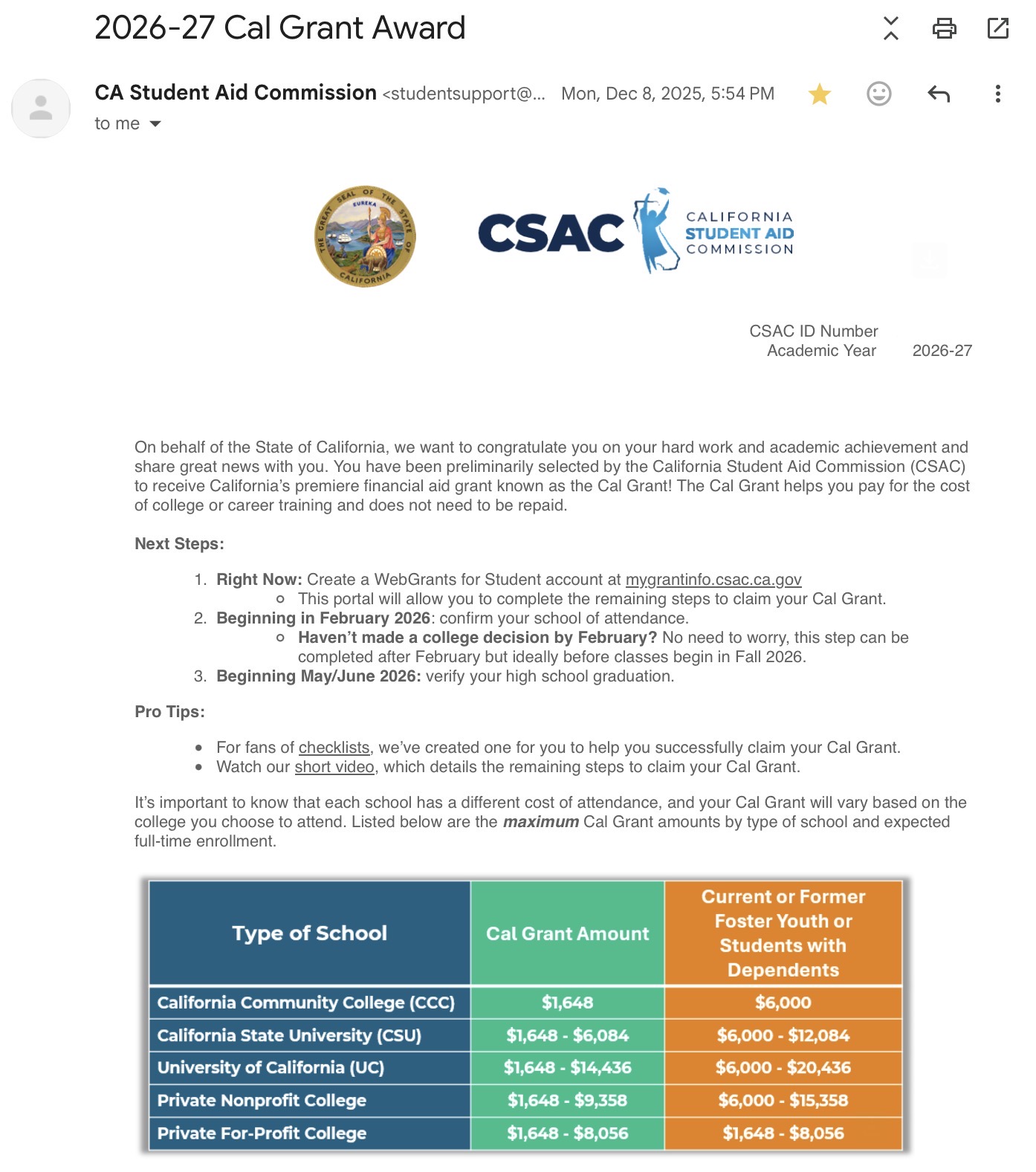
This process is easier than other private scholarships, which will be explained further later on, but there are two different ways to apply to the Cal Grant Program, FAFSA or CADAA.
The FAFSA, otherwise known as Free Application for Federal Student Aid, is an application operated by the U.S. Department of Education and the Office of Federal Student Aid (FSA) that allows students to qualify for federal, state, and institutional financial aid.
The CADAA, otherwise known as California Dream Act Application, is California’s state financial aid application operated by CSAC that allows undocumented and other eligible students to qualify for state and institutional financial aid.
You are eligible to apply to the FAFSA if you are a US citizen, are a permanent resident (a green card holder), have a T-Visa, or if you are an eligible non-citizen. To be eligible for the CADAA you must be undocumented, have a U-Visa or Temporary Protected Status, meet the CA non-resident expectation requirements, or be from mixed-status families. For more information click here.
Questbridge is a scholarship program that is made for lower income students to get into their dream schools. It is a program that is more geared towards students with primarily A’s and low incomes.

“I first heard about [Questbridge] in my math class, as a junior I’m definitely going to apply.” Alondra Osorio Lopez, an SAS junior, shares her introduction to Questbridge.
It is a program that does early admission applications, and for students who are juniors this year can start applying for Questbridge as early as September of this year. “I plan on applying as early as possible, the full ride aspect of the program is not only going to help me, but my family too.” Osorio Lopez explains.
The application requirements is as follows: provide information on your academics, activities, household, and financial background, a writing section, a letter of recommendation from a core-class teacher, providing your current high school transcript, any standardized test scores – if taken – (SATs, preACT, PSAT, etc), school profile (strongly recommended, and it’s strongly recommended to provide your previous year’ tax returns. For more information click here.
There are certain private scholarships that are for students looking to study specific niches that the scholarships fund. For example, the Placeworks program. This program funds unrepresented background students to specifically study degrees in urban design, architecture, environmental landscape, and related fields.
This might not apply to every underrepresented background student, not everyone wants a degree in that. Which is why if there is no desirable private program, it’s better to apply to wider public programs not tied to any studies.
Just as broader scholarships may not necessarily fit every student, but there are an abundant amount of scholarships that can fit anyone.
With or without scholarships, applying to college is a very difficult experience and stressful. But, scholarships can lighten the load of that weight of payments and help students focus on their future without debt. And hopefully bring education to everyone.